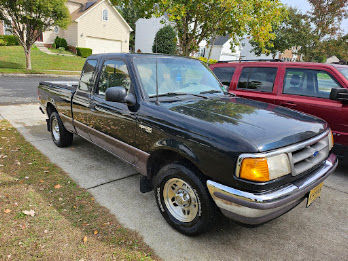
Why I’m Still Fixing a 1996 Ford Ranger
Most people think I’m crazy.
Every time someone asks about my truck, the next question is usually, “Why don’t you just buy another one?”
That’s a fair question.
The truck is a 1996 Ford Ranger XLT. It’s older than a lot of the people I work with. It doesn’t have a touchscreen, lane assist, heated seats, or a computer that nags you every time you change lanes. What it does have is character.
Unfortunately, it also had a cooling problem.
What started as “it just gets a little warm” turned into a months-long adventure involving radiators, water pumps, thermostats that somehow weren’t actually installed, second opinions, and more waiting than driving. At one point I wondered if the truck was spending more time in repair shops than on the road.
There were moments when it would have been easier to quit.
Friends told me to cut my losses.
Some suggested I should finance something newer.
Others reminded me that modern trucks are “more reliable.”
Maybe they’re right.
But every time I looked at the price of a newer truck, I couldn’t help thinking that I’d rather spend money fixing something I already own than spend years making payments on something I don’t.
Working in IT has taught me something.
Sometimes hardware isn’t worth repairing.
Sometimes it absolutely is.
The hard part is knowing the difference.
A twenty-year-old server that’s still doing its job? Keep it running.
A firewall that no longer receives security updates? Time to retire it.
A 1996 Ranger with only about 85,000 miles?
That’s a judgment call.
For me, it’s worth saving.
Maybe it’s nostalgia.
Maybe it’s because I enjoy understanding how things work.
Or maybe I just like proving that old equipment still has something left to give.
It’s the same reason I build Raspberry Pi projects from spare parts, rescue old Dell laptops for Linux experiments, and keep a home lab running hardware most people would recycle.
Technology doesn’t become useless because it gets old.
It becomes useful in different ways.
Whether it’s a vintage pickup truck or an aging computer, there’s satisfaction in bringing something back to life. You learn more from repairing a broken system than you ever will from replacing it.
Will the Ranger ever be perfect?
Probably not.
Will it eventually frustrate me again?
Almost certainly.
But one day, when it finally rolls out of the shop and I turn the key without wondering if the temperature gauge is about to ruin my afternoon, it’ll be worth it.
Not because I saved a truck.
Because I refused to give up on something that still had life left in it.
Sometimes the best projects aren’t the newest ones.
Sometimes they’re the ones everyone else already gave up on.