
Twelve Years of Hip Pain: Brian’s Experience With Legg-Calvé-Perthes Disease
It was almost Thanksgiving, and Brian was playing right guard for the Ocean City Hawks pee-wee football team. He was in sixth grade, about 12 years old, when we noticed he had developed a limp and was complaining about pain. At first, my wife and I figured it was probably football. Kids get banged up, and we assumed it would eventually go away.
It didn’t, so we took him to a doctor.
The doctor told us Brian had bilateral Legg-Calvé-Perthes disease, a childhood hip condition caused by a temporary loss of blood supply to the head of the femur. Both of his hips were affected.
Then she ran out of the room.
My wife and I looked at each other. I don’t think either of us had really processed what she had just told us. A few minutes later, the doctor came back in, told us Brian would need a wheelchair for a while, and left again.
We later learned that something had happened to her daughter. I think she had been cut or hurt somehow, so the doctor was understandably preoccupied. At the time, though, all we knew was that our 12-year-old son had just been diagnosed with a disease we had never heard of and would now need a wheelchair.
We were devastated.
For about the next year, we did what we were told. Brian used a wheelchair, we got him to school, carried the chair up and down stairs, and adjusted our lives around what he could and could not do.
Eventually, we met Dr. Wudbhav Sankar. I remember him describing the wheelchair treatment as “barbaric.” He believed surgery was the better option, and the way I remember it being explained to us was that the surgery would “fix” Brian’s problem.
So we agreed.
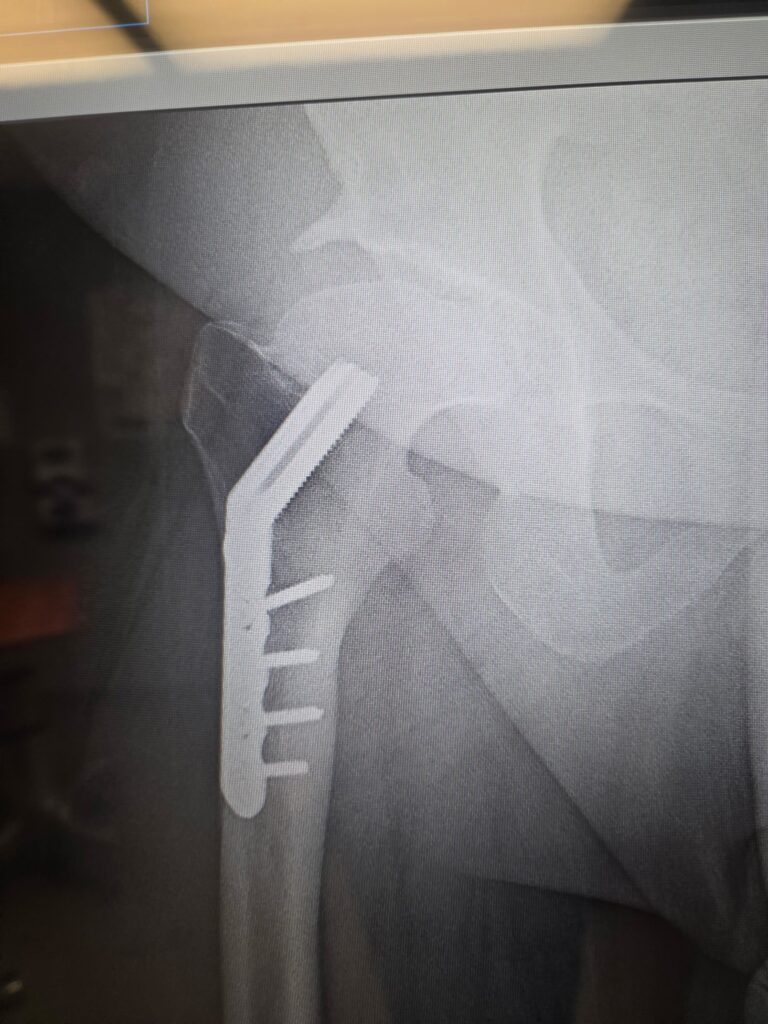
In 2015, Brian went through an operation that lasted around eight hours. A metal plate and screws were placed around his right upper femur and hip. Recovery took months, but after he started walking again, the pain was still there.
It never really went away.
Brian walked differently after the surgery, and the hip continued to hurt. That pain remained part of his life for the next 12 years.
Another Diagnosis
When Brian was about 15, he was diagnosed with Type 1 diabetes.
That was another slap to the face.
I remember my wife buying a scale and carefully counting carbohydrates. In the beginning, there was a lot to learn, and we tried to manage as much of it as possible for him. Over time, like most things involving your children, the responsibility shifted.
Brian got older and started managing it himself. Today he has an insulin pump, and that has been a game changer.
The diabetes became something he learned to manage. The hip pain was different. It stayed with him.
Brian is 24 now, and over the years his hip has given out badly enough that he has fallen down the stairs. Long walks were difficult, and when we went grocery shopping or did something similar, he sometimes had to use a cane.
There is something strange about seeing a 24-year-old walking around with a cane. People look. Brian notices it, and so do we.
For years, we tried to find a doctor willing to remove the old hardware and do something about the hip itself. Nobody wanted to touch it.
Eventually, we found Dr. Tuan “Mickey” Bui.
For the first time in a long time, it felt like someone was willing to help him.
August 31, 2026
Brian’s surgery was scheduled for August 31, 2026, at Shore Memorial in Somers Point, New Jersey, the same hospital where he was born.
The plan was to remove the old hardware and reconstruct the femoral head. We were told the procedure would probably take about an hour. Brian would wake up in recovery, and the expectation was that he would go home afterward.
We arrived at the hospital around 5:30 in the morning. Eventually, Brian was called back. My wife and I kissed him goodbye and wished him luck.
Then we waited.
The hospital had a surgical status board. Green meant the patient was still in the operating room. After the first hour Brian was still green. Then the second hour passed, then the third, then the fourth. By the fifth hour, the board still showed green, and we started asking what was going on.
A nurse eventually came out and told us there had been complications, although she didn’t know much more than that. She told us the doctor would come speak with us.
Eventually, Dr. Bui came out.
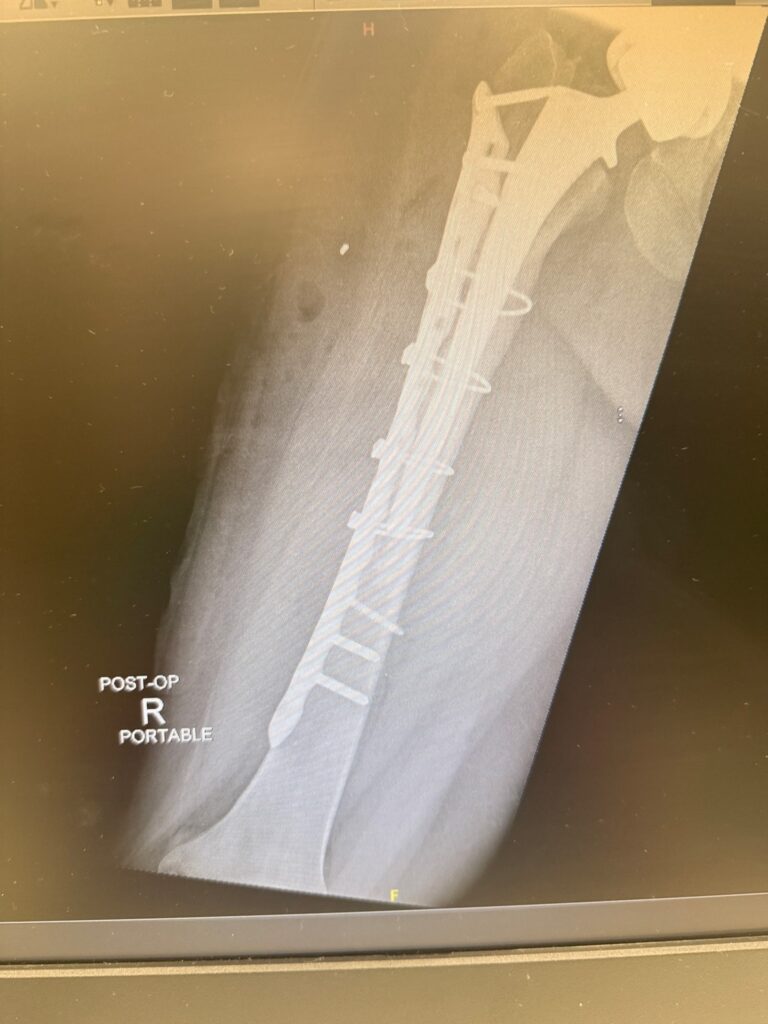
The problem had been the last screw holding the old plate in place. The head of the screw broke off, leaving the remaining portion embedded in the bone. To remove it, they had to drill around the screw, and during that process Brian’s femur fractured.
He also lost enough blood that he needed transfusions.
Dr. Bui explained what happened and assured us that once everything healed, Brian should no longer have the hip pain he had been living with for 12 years.
The operation that was supposed to take about an hour ended up taking around five.
When we were finally allowed to see Brian, he looked awful. He was yellow, his head was moving back and forth, and he was completely out of it. All I could think about was how this was supposed to have been a short operation followed by recovery and home.
I kept telling anyone involved in his care that when Brian woke up, he was not going to understand what had happened. As far as he knew, he had gone in for an hour-long surgery. Instead, he had fractured his femur during the procedure, lost a significant amount of blood, and needed transfusions.
We eventually left the hospital around 5:30 that evening.
Around 3 a.m., the phone rang.
It was Brian.
My wife answered. He was crying, angry, confused, and scared. She did her best to calm him down, and we told him we would be there at 8 a.m.
We were.
The Bed Move
When we arrived, Brian told us that he had been moved during the night. He said that while they were moving him, it felt like lightning and fire were shooting up his leg.
He also told us that during the move, one of the nurses complained that he was breathing in her face.
I wanted to know why he had been moved in the first place.
I went to the nurses’ station and asked who had moved my son. A nurse told me she had. When I asked why, she said the bed alarm wasn’t working, so he was moved for his safety.
I hate that excuse.
I wanted to know whether anyone inspected the beds to make sure the alarms and other safety systems were working before patients were put in them. I was told no.
I also wanted the paperwork showing that Brian had been moved and why. I was told that moving a patient from one bed to another was not something they normally added to the medical chart.
At some point, the nurse told me that it seemed like I wanted to fight.
I was angry, but I wasn’t trying to fight anyone. I wanted answers.
Brian had just fractured his femur during surgery. He had lost enough blood to require transfusions, and now he was telling us that he had been moved during the night and experienced severe pain while it happened.
The nurse also mentioned her two years of experience at the hospital.
That probably wasn’t quite as reassuring as she intended it to be.
Back to the Hospital
Brian was eventually released, but after the next night he ended up going back to the emergency room by ambulance.
His hemoglobin level was extremely low. I believe it was around 6.6, although that number is from memory. He was readmitted for “observation.”
He received another blood transfusion and then another after being moved to his room.
By that point, I had gone into work. I was trying to function normally, but I wasn’t doing very well.
Then I saw my boss and some of my coworkers. Jaclyn asked me how Brian was doing.
That was pretty much all it took.
I don’t have much family left, so when something serious happens, most of the time the person I talk to is my wife. When Jaclyn asked about Brian, everything I had been holding in started coming out.
I started shaking and almost crying, and the whole thing poured out of me like a waterfall in a rainforest.
My boss came in and told me to do whatever I needed to do.
So I went back to the hospital.
Hospital Food
One thing I will say about Shore Memorial is that the food mostly sucks.
The burgers were cold and dry. The fries were soggy and cold, and it seemed like they had been sitting under a heat lamp for hours.
Breakfast was the exception.
The over-easy eggs, breakfast potatoes, and small sausage patty reminded me a little of breakfast from my days working at Resorts.
When you spend enough time in a hospital, apparently you start reviewing the food.
The Catheter Problem
Another problem Brian had during recovery was urinating. His bladder would fill, but he could not go to the bathroom normally and relieve the pressure.
The staff used an external catheter, sometimes called a Texas catheter, which is not inserted into the urethra.
For Brian, catheterization has a history.
During his first surgery, he had four catheterizations. As I remember it, three of them were done incorrectly.
That experience stayed with him.
He was a kid when it happened, but years later, the memory of it was still there.
Where Things Stand Now
Brian is home now.
He is using a walker and cannot put weight on the affected leg yet. Dr. Bui expects him to stay off it for a few weeks while the femur heals. The larger plate visible in the newer X-ray is now stabilizing the femur after the fracture.
The good news is that the original hip pain is gone.
That is probably the biggest thing in this entire story.
For 12 years, Brian lived with pain from that hip. He adjusted how he walked, how far he could go, and what he could comfortably do.
Now, even while recovering from a fractured femur and another major surgery, he is already noticing things that are different.
He recently texted me that he could lean over in his chair and pet Stella, his cat, without getting that whipping pain down his leg.
I get excited when I hear things like that because it shows me he is mending. It is a small thing, but it is a sign that recovery is moving in the right direction.
There is still the left hip.
Brian’s Perthes disease was bilateral, and at some point that side may also need to be addressed. After everything he has just gone through, Brian is not sure he wants to do it.
I don’t blame him.
For now, he is home, he is healing, and after 12 years, the pain in his right hip is gone.