
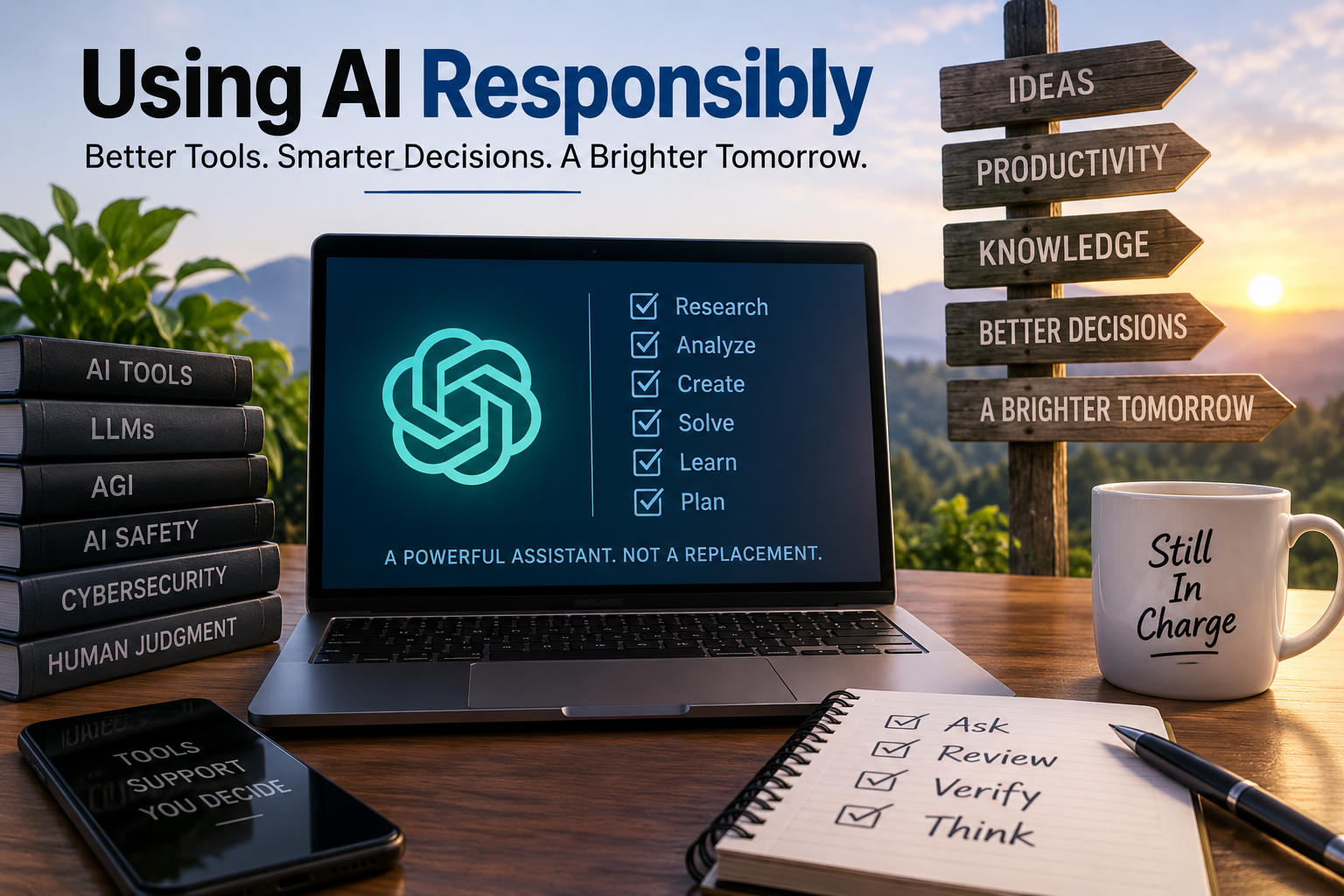
My Take on AI
Using AI responsibly is something I have been thinking about a lot lately, especially after a conversation with my son about how people use AI to perform tasks for them, some of them rather important, like building a résumé.
While building a résumé is a daunting task, I wonder how many people would simply input their skills, past jobs, dates, names, certifications, degrees, and then submit everything to their chatbot of choice.
That’s it. Done.
I would hope that person has the thoughtfulness to at least review what was given back to them, but my faith in humanity doesn’t quite reach that level. So, next thing you know, your last skill is telling people the difference between gummy bear flavors.
Using AI in this manner is shameful. It’s outright dumb.
The second topic involving AI is far more serious: the possibility that future artificial intelligence systems could eventually become powerful enough to threaten humanity.
Before going any further, I think it is important to define what we are actually talking about, because the terminology gets thrown around so loosely that everything starts sounding like the same thing.
Artificial intelligence, or AI, is the broad category.
ChatGPT, Claude, Gemini, and similar systems fall underneath that larger umbrella.
Most of the systems people interact with today are built around Large Language Models, or LLMs. These models are trained on enormous amounts of information and are especially good at working with language, although modern systems can also work with images, software tools, code, documents, and other forms of information.
That is what I am mostly talking about when I describe the AI I use every day.
Then there is AGI — Artificial General Intelligence.
There is no single universally accepted definition of AGI, which is part of the problem when people discuss it. Generally speaking, the term refers to an AI system capable of performing a very broad range of intellectual tasks at roughly human level or beyond, rather than being especially capable in only a narrow area.
Even the companies building these systems do not necessarily describe AGI as one dramatic moment when a machine suddenly becomes intelligent. OpenAI, for example, has described AGI more as a progression through increasingly capable systems rather than one giant leap.
Then we get to superintelligence.
That is something different again.
Superintelligence generally refers to a hypothetical AI system that would significantly exceed human capability across many important areas, including the abilities of highly trained human experts.
And that is where many of the most serious warnings begin.
Researchers raising concerns about human extinction are not generally arguing that the chatbot sitting on my computer today is about to become self-aware and start wiping us out.
They are worried about what could happen later if AI systems become much more capable, much more autonomous, and possibly capable of improving themselves with less human involvement.
That last part is especially important.
A system capable of helping design or improve the next generation of itself could potentially accelerate AI development far faster than humans could manage manually. Researchers sometimes refer to this idea as recursive self-improvement.
Whether that actually happens is unknown.
But the possibility is serious enough that people working inside the industry are publicly discussing it.
Evan Hubinger, Anthropic’s Alignment Science Lead, recently wrote that he and his colleagues genuinely believe AI could kill all humans. He said his own estimate of that happening within the next decade is greater than 10 percent.
That number is Hubinger’s personal estimate.
It is not Anthropic announcing that humanity has a 10 percent chance of disappearing, and it is certainly not a scientific consensus.
But I do think it deserves attention when someone whose job is specifically focused on AI alignment is willing to say that publicly.
Jacob Coxon, a researcher who has worked on pretraining research at both OpenAI and Anthropic, has raised similar concerns. When discussing the direction of frontier AI development, he warned that companies were “racing straight to self-improving superintelligence and gambling with our lives.”
The phrase self-improving superintelligence is really the key to understanding what he means.
He is not talking about asking ChatGPT to fix a PowerShell script.
He is talking about a theoretical future system with vastly greater capabilities, greater autonomy, and potentially the ability to participate in improving its own successors.
That is a very different conversation.
The AI companies themselves make this distinction.
Anthropic has said that present-day models show early warning signs in areas such as cybersecurity and biology, but that current models still fall short of the capability levels it considers substantially dangerous to national security.
OpenAI has also written that the risks associated with possible future superintelligent systems could be catastrophic and that such systems would require much stronger alignment, control, and governance before deployment.
So I think there are really two AI conversations happening at the same time.
One is about the AI we actually have today.
That conversation involves things like inaccurate answers, hallucinations, privacy, cybersecurity, misinformation, employment disruption, overdependence on automation, and people trusting AI without checking its work.
Those are real problems happening now.
The second conversation is about what AI may eventually become.
That is where AGI, superintelligence, recursive self-improvement, loss of human control, and existential risk enter the discussion.
Those risks are much more uncertain.
They are also potentially much larger.
I do not pretend to know whether superintelligence will happen, whether it will happen in ten years, fifty years, or never.
And I certainly do not know whether it would turn against humanity.
What interests me is that some of the people closest to the technology believe the possibility is serious enough that we should be discussing it now.
That is very different from saying the end of humanity is coming.
It means the people building the technology are admitting that they do not completely know where it leads.
And neither do I.
Using AI Responsibly
So, this is why I am writing this.
What interests me much more is the part of AI that already exists and that I find genuinely useful.
Just like Musk did, AI is my team, and I am the Descion Maker.
I started my career around 1995. I have worked in sales, repairs, set up cyber cafés, built networks, and designed infrastructure. I started working for a mom-and-pop business, then moved into radio, then corporate, more corporate, municipal government, the gaming industry — casinos — media outlets, owned my own business, and now I am back to a mom-and-pop business.
Through all those years, I was never a programmer.
So, it could take me weeks to get the code snippets I needed to perform some action.
Then along came AI.
When AI tools first became widely available, I took a few prompt-engineering classes. Since I mainly live in ChatGPT, I will focus on that particular system, although the broader changes are happening across the AI industry.
The difference between the language models people were using around 2022 and the systems available today is enormous.
The underlying technology still generates language largely by predicting tokens, essentially determining what should come next based on the information and context available to it. That basic concept has not disappeared.
What has changed dramatically is everything built around it.
Modern frontier AI systems can spend additional computation on difficult problems, work with images and other forms of input, search or retrieve information, use external tools, write and execute code in certain environments, and carry out multi-step tasks.
That is a very different experience from simply typing a question into an early chatbot and receiving one immediate response.
And the advancement has happened remarkably quickly.
I originally thought about bringing Moore’s Law into this discussion, but it really doesn’t belong here. Moore’s Law concerns the historical growth in transistor density on integrated circuits, not a rule stating that technology changes every ten years.
My point is much simpler.
I have worked in technology for roughly thirty years, and I cannot remember many technologies changing this visibly, this quickly, right in front of the people using them.
There is plenty of debate among researchers about where current LLM technology goes from here.
Some researchers believe simply making models larger will eventually produce diminishing returns. Others believe major improvements can still come from better training methods, more computation during inference, better tools, new architectures, and systems that combine multiple approaches.
There is no scientific consensus that LLMs are “dead,” and there is no established evidence that they have reached some final peak of human-like intelligence.
So where does that lead us?
I’ll say it plainly:
I don’t know.
There will be no prediction in this paper about when AGI arrives, whether machines become smarter than humans, or whether some future AI eventually decides humanity is unnecessary.
This is simply about my view of the AI systems we actually have today and how I use them.
I also want to note that I am writing this in Microsoft Word.
I am typing it myself.
Human fingers are hitting the keyboard and making hundreds of spelling and typing mistakes.
The overall approach is to eventually feed this into a ChatGPT project I created called “My Personal Writer.”
I use ChatGPT Plus and pay about $20 per month for the service.
I have around twenty projects covering everything from scripting projects and investing to my cars, plants, and other interests. I also have hundreds of chats.
But chats and projects are different.
A normal chat is essentially an individual conversation with the AI.
A project is a workspace built around a continuing subject or purpose. Projects can keep related chats, uploaded files, instructions, and other context together so I do not have to continuously rebuild that background every time I start another conversation.
One good example is my project called “Project 2025.”
Here, I instructed the model to follow rules such as:
You are my research partner for examining Project 2025 from three primary perspectives:
- Political
- Legal / Constitutional
- Religious / Theological
The goal is analysis, not advocacy. Do not assume Project 2025 is good or bad. Follow the evidence, distinguish fact from opinion, and present strong arguments from multiple viewpoints.
The complete project instructions are more than 1,000 words, which is far too long to include here, but some of the major categories include:
- Research Standards
- Political Perspective
- Legal / Constitutional Perspective
- Religious / Theological Perspective
- Fact Checking
- Implementation Tracking
- Neutrality
- Historical Context
- Questions to Answer
- Preferred Response Structure
- Writing Style
Each category has its own subsection with additional rules that guide how the AI should approach the material.
One of the best parts about this project is that I uploaded the full Project 2025 document from Heritage.org.
That means when I ask questions, I can instruct ChatGPT to base its answers on the document itself and point me back to the relevant section, passage, or source material it used. In many cases, that makes it much easier to go back to the original document and verify the answer for myself instead of simply trusting what it tells me.
To be honest, I almost wrote “they” instead of “it.”
Bad Brody.
This project is almost like having a personal research assistant examining Project 2025 with me.
I can use it to compare statements being made about the document against what the document actually says.
That does not mean I blindly trust the AI.
Quite the opposite.
It gives me another tool for finding the section, checking the wording, comparing claims, and deciding for myself whether the evidence supports what somebody is saying.
And that, to me, is what using AI responsibly really means.
The AI can help research, organize, explain, compare, and even challenge what I think I know.
But it should not replace the person making the decision.
So, when you are thinking about running that résumé through AI, maybe don’t just open a chatbot and say:
“Make me a résumé.”
Give it instructions.
Give it the real information.
Tell it not to invent anything.
Tell it to question you when information is missing.
Then review every single thing it produces.
Use AI as a tool.
Use it as a team.
Just remember who is supposed to be in charge.