
I’ve Been Fixing Computers Longer Than Google Has Existed
Fixing computers before Google existed meant learning things differently.
There was a time when getting a bunch of computers to talk to each other was almost as much fun as the game we were trying to play.
At least that’s how I remember it.
This was before high-speed Internet was something everyone had at home. Before Wi-Fi was everywhere. Before you could install a game, click a button, and instantly join your friends online.
If we wanted to play together, we built a LAN.
And sometimes, we literally drove around with computers in our cars looking for somewhere to build one.
Building Computers in the K6-2 Days
I was building my own computers back then. One of the processors I remember was the AMD K6-2, which arrived with AMD’s 3DNow! technology.
At the time, that stuff was exciting.
Today we look at processors with ridiculous numbers of cores, GPUs with gigabytes of memory, and Internet connections measured in hundreds of megabits or even gigabits per second.
Back then, I remember being excited about AMD processors and ATI video cards. You picked out your motherboard, processor, memory, video card, sound card, network card, hard drive, and everything else and put the machine together yourself.
Then you hoped the damn thing booted.
If it didn’t, you figured out why.
I didn’t realize it at the time, but that process was teaching me something that would eventually become a career.
The LAN Party
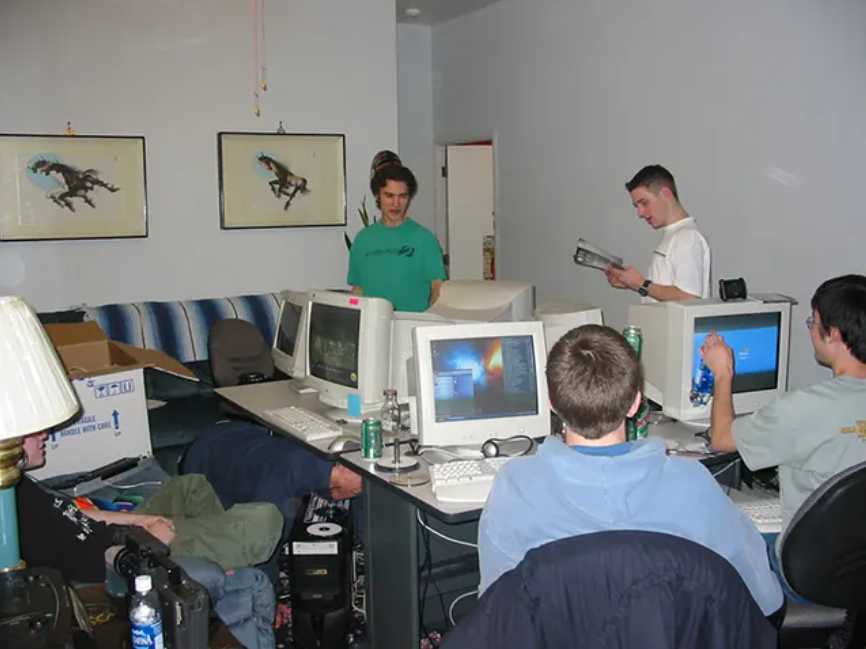
A few friends with computers could turn just about anywhere into a LAN party. We’d load our machines into our cars, drive somewhere, unload everything, and start wiring it together. Computers, monitors, keyboards, mice, network cables, power strips—we brought everything with us.
Then came the troubleshooting. Someone couldn’t see the network, someone couldn’t see the game, something wasn’t configured correctly, a cable didn’t work, or a computer simply decided that today was the day it wasn’t going to cooperate. And somehow, I became the guy who could usually fix it.
Once everything was working, we’d play games like Counter-Strike and Team Fortress Classic for hours. Those games were great, but looking back, I think getting everything working was part of the fun for me too.
That’s the format I’d use for the entire article: paragraphs of roughly 2–5 sentences, with an occasional single sentence only when it actually deserves emphasis.
From 30 Minutes to 10
Around that time, I was also going to night school for my CompTIA A+ certification. I was learning computers formally in class while also learning them the way that probably taught me the most: by constantly building things, breaking things, and figuring out how to fix them.
When we first started putting together these LAN parties, it might take me around 30 minutes to get everything configured and working. We kept doing it, and every few weeks we’d get the computers together again. Each time, I became a little faster until something that once took me half an hour was taking about 10 minutes.
One of my friends noticed and said something along the lines of, “You’re getting better and better at this.” I don’t remember his exact words after all these years, but I remember what he meant, and I remember the feeling. He was right. I was getting better.
It wasn’t because I’d memorized some procedure. I was starting to understand how everything fit together. If something broke, I could usually figure out why and fix it. That’s a pretty powerful feeling when you’re young and still trying to figure out what you’re actually good at.
Two Computers. One Modem.
Then there was the Internet. Calling what we had an “Internet connection” compared to what we have today almost feels generous. We had a dial-up modem, and at some point I managed to share that connection between two computers, which meant both machines could actually get onto the Internet at the same time.
Naturally, there was only one reasonable thing to do with this incredible technological achievement: we tried to play games over it. And somehow, it worked. Sort of. It was choppy as hell, but it worked, and that’s the part I remember.
Today, if a game starts lagging, we’re checking latency, bandwidth, Wi-Fi signal strength, and blaming the ISP. Back then, we had two computers fighting over a dial-up connection and still managed to play a game over the Internet. We weren’t worried about how terrible the connection was. We were amazed that we’d gotten it to work at all.
That was enough
When Troubleshooting Was Part of the Fun
Looking back, those LAN parties probably taught me more than I realized. There was no cloud dashboard telling me what was wrong, there wasn’t a YouTube video for every problem, and you couldn’t always just Google the error message. In fact, Google itself was only founded in 1998, right around the same era as the AMD K6-2.
You had manuals, friends, and whatever knowledge you’d accumulated from the last thing that broke. A lot of troubleshooting was experimenting. You’d change something and try again. If it didn’t work, you’d put it back and try something else.
Eventually, you developed an instinct for troubleshooting and started recognizing patterns. Instead of randomly changing settings, you began thinking about what the computer was actually trying to do and why it wasn’t doing it.
That’s really the skill that stuck with me. The technology changed, but the troubleshooting didn’t.
From LAN Parties to IT
Something broke, and I fixed it. Then something else broke, and I fixed that too. Eventually, people started expecting that if there was a problem, I’d probably figure it out.
Decades later, the systems are considerably more complicated. Servers became virtual machines, networks became much larger, and security became a completely different world. Linux became part of my everyday life. Now there are firewalls, SIEMs, cloud platforms, containers, automation, cybersecurity tools, and artificial intelligence.
But underneath all of that is still the same process I was learning while crawling behind somebody’s computer at a LAN party: What’s broken? What changed? What should be happening? What is actually happening? How do I get from one to the other?
Man, I Miss Those Times
Technology today is objectively better. I don’t want my dial-up modem back, I don’t want to wait for downloads, and I certainly don’t miss driver problems, IRQ conflicts, or hauling a CRT monitor around just so we could play a game.
But I do miss that era. I miss throwing computers into cars and driving around to put together a LAN party. I miss finally getting everybody connected. I miss Counter-Strike and Team Fortress Classic with friends sitting in the same room. I miss the excitement of getting two computers onto the Internet through one lousy modem connection and being amazed that it worked at all.
Most of all, I think I miss that feeling that computers were still something you could completely take apart, understand, rebuild, screw up, and fix again.
Every few weeks, that LAN took a little less time to build. Thirty minutes became ten. Problems that once stopped me eventually became things I could solve without thinking much about them. My friend noticed I was getting better before I really thought about what that meant.
Looking back now, I think those nights were the beginning of something. I was learning how to troubleshoot and how computers communicated. More importantly, I was learning that I genuinely enjoyed figuring out why things didn’t work.
I just didn’t know yet that I was learning skills I’d still be using decades later.
We thought we were just trying to play Counter-Strike. Turns out, I was building a career. And man, I miss those times.
Key Takeaways
- Some of my earliest hands-on IT experience came from building PCs and troubleshooting home networks.
- The AMD K6-2 and the early 3D gaming era were part of the period when I became fascinated with computer hardware.
- LAN parties provided real-world lessons in networking and troubleshooting without feeling like lessons at all.
- Studying for my A+ certification gave me formal knowledge while constantly building and fixing computers gave me practical experience.
- Going from roughly 30 minutes to 10 minutes to configure our LAN was one of the first times I realized my technical skills were genuinely improving.
- The technology has changed dramatically, but the basic troubleshooting mindset hasn’t.
- Sometimes the experiences that shape a career don’t look anything like career development while they’re happening.